

Every organisation has a written privacy policy. Very few know what their real privacy policy actually is — the one enforced not by a document sitting in a shared drive, but by hundreds of small decisions employees make every day, often at the worst possible moment: late Friday afternoon, ten minutes from the weekend, deep into an inbox nobody wants to look at again until Monday.
That's the moment an organisation's true privacy culture reveals itself. Not in the policy PDF. In the click.
As India's Digital Personal Data Protection (DPDP) Act moves toward full enforceability, organisations are discovering an uncomfortable truth: compliance on paper and compliance in practice are two very different things. Legal teams can draft airtight policies. Security teams can deploy world-class tools. None of it matters if the person hitting "send" doesn't pause for one extra second first.
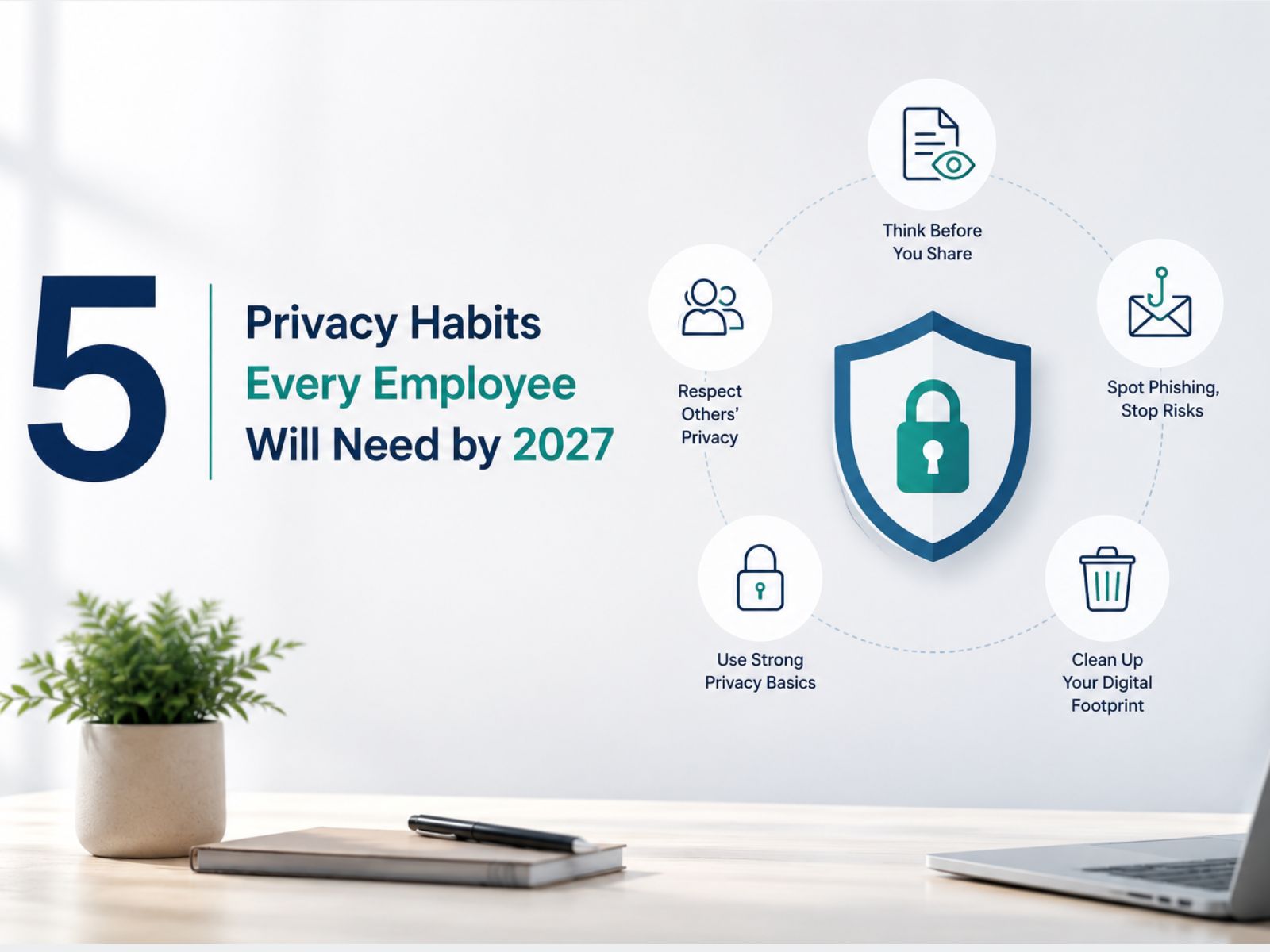
This is why the cyber hygiene community keeps returning to the same conclusion, training after training: privacy is not a policy problem — it's a habit problem. And habits have to be built deliberately, not assumed. Here are the five we consider essential heading into 2027.
1. Think Before the Send
Before any personal data leaves your hands — over email, over chat apps, into a third-party portal — there's one question worth two seconds of your time: is this the approved channel for this kind of data?
It sounds almost too simple to matter, yet it's the single highest-leverage habit an employee can build. The statistic that keeps surfacing across industries is this: most data incidents aren't the result of sophisticated hacking. They're the result of ordinary sharing that went to the wrong place. A file meant for one team lands in the wrong inbox. A customer record meant for internal use ends up copied onto a personal laptop "just to finish over the weekend." No firewall stops this, because nothing was technically breached — something was simply sent without a second thought.
2. Collect Less, Not More
Every form in an organisation carries its own history. Fields get added over the years — "a past vendor needed it," "someone might ask eventually" — and almost never get removed. The result: most companies quietly hold far more personal data than any current task actually requires.
This is more consequential than it looks. Under data minimisation principles, now a legal expectation rather than a nice-to-have, every unnecessary field collected is not convenience — it's exposure with no upside. Data that was never gathered can't be leaked, misused, or subpoenaed. The habit is a discipline of restraint: ask what the task genuinely needs, not what the form has always asked for.
3. Treat Your Desk Like It's Being Watched
This is the least glamorous habit on the list — and arguably the most telling. Locking your screen the moment you step away. Never parking customer data on a personal device "just temporarily." Never letting a printout sit unclaimed at the printer while you're pulled into a meeting.
None of this takes technical skill. It takes only consistency, which is exactly why it's usually the first thing to slip. An unlocked screen or an abandoned printout tells anyone watching everything they need to know about how seriously an organisation treats the data it holds — regardless of what the policy manual says.
4. Verify Before You Trust
Social engineering rarely breaks through firewalls. It walks through the front door, politely, and asks to be let in — a caller claiming to be a customer, a "colleague" requesting one quick file outside the normal process, someone presenting as an auditor with just enough confidence that questioning them feels awkward.
The habit that defeats this is simple in principle and hard in practice: verify identity every time, regardless of how urgent, senior, or familiar the request sounds. Organisations that get compromised this way are rarely the ones with weak technology — they're the ones where employees were never explicitly told it's okay to pause and check first.
5. Speak Up Immediately
The final habit determines whether the other four actually matter. A slip happens — a misdirected email, a file left exposed, a request that felt slightly off. What happens in the next sixty minutes decides everything.
Flagged within the hour, it's a near-miss: contained, documented, often resolved before it needs to be formally reported at all. Left unspoken, out of embarrassment or hope that no one noticed, it becomes something far worse — an incident, and often, a cover-up. Regulators rarely distinguish kindly between an honest mistake disclosed quickly and an honest mistake buried.
The Thread Running Through All Five
None of these habits require a law degree. None require technical certification. What they require is culture — and culture isn't built by a policy sitting unread in a shared drive. It's built through training that treats every employee as the actual frontline of data protection, not a name on a compliance checklist ticked once a year.
As DPDP obligations shift from "upcoming" to enforceable, the organisations that will be ready aren't necessarily the ones with the biggest legal teams. They're the ones whose employees pause before sending, collect only what's needed, lock their screens on instinct, verify before trusting, and raise a hand the moment something looks wrong.
That's what real workforce privacy training builds — not lectures people forget by lunch, but reflexes they carry into every ordinary Friday afternoon.
"Firewalls protect networks. Habits protect people. By 2027, the organisations that survive regulatory scrutiny won't be the ones with the thickest policy manual — they'll be the ones whose employees never had to open it."
Cyber Hygiene Community



Project Cordinator
You May Also Like It

Cyber threats are constantly evolving, and one category of malware

In the fast-paced world of Kenyan business, data is gold.
Leave A Comment
Don’t worry ! your e-mail address will not published.
0 Comments